Beautiful Broken: Why We Can't Stop Aestheticizing the Internet's Failures
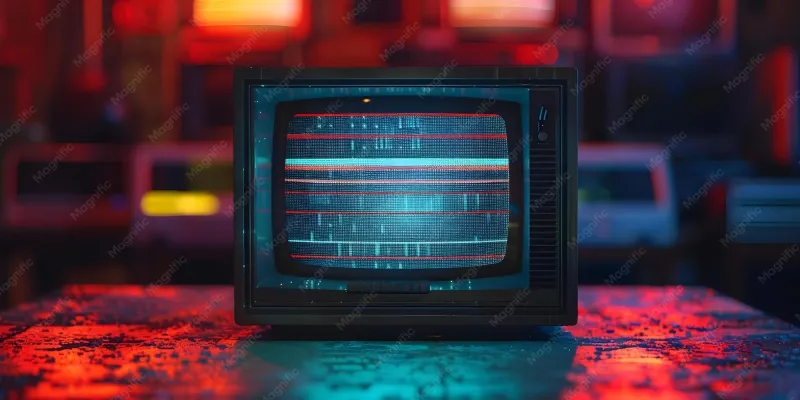
Photo: VHS glitch aesthetic retro television static screen art, via img.freepik.com
Somewhere between a perfectly color-graded Instagram post and a corrupted JPEG from 2003, a whole aesthetic movement found its home. It's called a lot of things depending on who you ask — glitchcore, lo-fi web, vaporwave-adjacent, analog revival. But the common thread is the same: an obsession with the look of things going wrong.
Distorted fonts. Scan lines draped over selfies. Websites that look like they were abandoned in 1997 and recently excavated. GIFs compressed into near-abstraction. These aren't accidents. They're choices — deliberate, considered, and increasingly central to how younger creators online define their visual identity.
So what's actually going on here?
The Hyperpolished Problem
To understand the appeal of broken aesthetics, you first have to sit with what they're reacting against. The dominant visual language of the mainstream internet right now — particularly on Instagram, TikTok, and YouTube — is aggressively, exhaustingly polished. Everything is lit correctly, color-corrected into a specific mood palette, and edited with a smoothness that borders on uncanny.
This didn't happen by accident. Platforms incentivize a certain kind of visual quality because it keeps users engaged. Algorithms favor content that looks professional, which pushes creators toward a kind of visual convergence. The result is a feed that, even when it's technically beautiful, starts to feel deeply artificial.
When everything looks perfect, perfection stops meaning anything. And when perfection stops meaning anything, imperfection starts to look like honesty.
The VHS Revival Isn't About VHS
It's tempting to read the VHS filter craze or the resurgence of film grain as pure nostalgia — millennials pining for childhood, Gen Z romanticizing a past they didn't actually live through. And sure, there's some of that happening. But reducing it to nostalgia misses what's actually interesting about the trend.
For a lot of creators, the VHS aesthetic isn't about the 1980s or 90s specifically. It's about what those visual artifacts communicate: impermanence, authenticity, the sense that something real happened and was imperfectly recorded. A VHS-filtered video looks like a memory. It looks like something that mattered enough to someone that they pointed a camera at it, even if the camera wasn't great.
Contrast that with a 4K, stabilized, color-graded TikTok that looks like it was produced by a small marketing team — because increasingly, it was. The polish signals effort, but it also signals performance. The grain signals something closer to truth, even when it's entirely constructed.
Gen Z in particular has grown up in an environment where the line between authentic content and branded content is essentially invisible. They've developed a finely tuned skepticism toward anything that looks too intentional. Paradoxically, the intentionally broken aesthetic reads as more genuine precisely because it looks like less effort was put into making it look good.
Glitch as Grammar
Beyond the VHS wave, there's a broader visual vocabulary emerging around glitch aesthetics that's worth paying attention to. Corrupted images, datamoshing, pixel sorting, RGB channel splitting — these are techniques borrowed from digital error and repurposed as expressive tools.
What's interesting about glitch art specifically is that it's pulling meaning from the visual language of failure. A corrupted file is, in its original context, a problem — information that didn't survive the transfer. But in an aesthetic context, that same corruption becomes a kind of mark-making. The error tells you something about the process. It makes the medium visible in a way that clean, seamless digital production doesn't.
There's a long art-historical thread here if you want to pull it — from the Dadaists embracing chance and error, to the punk movement's deliberate ugliness, to early net art in the 90s that played with browser failures and broken HTML. The current glitch aesthetic is part of that lineage, even if most of the teenagers making glitched-out profile pictures have never heard of Jodi.org.
The Ugly Web Comeback
Separately — and maybe most interestingly — there's a growing movement around what people are calling the "small web" or "indie web," which is less about visual glitch and more about structural ugliness. Websites that look deliberately hand-coded. Tiled backgrounds. Comic Sans used without irony. Blinking text. Guestbooks.
This is a direct formal rejection of the sleek, template-driven design that dominates the modern web. Sites built on Squarespace or Wix or any major CMS tend to look more or less the same — clean, responsive, professional. The indie web movement is building things that look weird on purpose, that resist the grid, that feel like they were made by a specific person rather than optimized by a design system.
Neocities — a hosting platform explicitly modeled on the old GeoCities — has seen consistent growth over the past few years, driven largely by younger users who weren't alive when GeoCities was actually relevant. They're not recreating the past. They're using the past's aesthetic vocabulary to say something about the present.
Identity in the Artifact
At its core, all of this — the VHS filters, the glitch art, the intentionally ugly websites — is about identity and ownership in an environment that increasingly feels like it belongs to platforms rather than people.
When your profile exists on Instagram or TikTok, it lives inside a design system you didn't choose, governed by an algorithm you can't see, on a platform that could change the rules tomorrow. The aesthetic you build inside that system is always constrained by the container.
The broken aesthetic, in a lot of ways, is an attempt to break the container. To make something that looks like it came from somewhere specific, was made by someone specific, and can't be easily replicated by a template. The imperfection is the fingerprint.
In a digital landscape that's getting smoother, faster, and more frictionless by the year, a little static might be exactly what authenticity looks like.